English football fans tend to assume that the 1966 World Cup win was a confirmation of the natural order. The country that gave football to the world had given Johnny Foreigner a masterclass at the sport’s hallowed cathedral, Wembley Stadium. Football had come home.
In fact, England’s right to host the tournament owed more to nostalgia than their record on the pitch. In the four tournaments they entered before 1966, England played 14 matches and won just three. The furthest they ventured was the quarter-finals, losing to Uruguay in 1954 and Brazil in 1962. A league table of the 28 teams who played in those World Cups, based on three points for a win, would put England in seventh place behind Hungary, Sweden and Yugoslavia. Their points-per-game ratio of 1 represents relegation form in a domestic league. England were, to borrow a popular phrase, the perennial underachievers of world football.
England, captained by Billy Wright, stepped off the plane in Brazil in 1950 brimming with self-confidence, having won 23 of their 30 matches since the war. Not for the last time, they perceived themselves to be the overwhelming pre-tournament favourites. The team was packed with household names such as Stanley Matthews, Stan Mortensen and Tom Finney. Home and away victories against double world champions Italy had convinced them in their own minds that they were the best team in the world. But the Italians were no longer the force they had been in the 1930s, as their postwar results showed: they failed to get out of the group stages until 1970 and were knocked out in the qualifying rounds in 1958 by Northern Ireland. In 1966 they would lose 1-0 to North Korea on their way to another early exit.
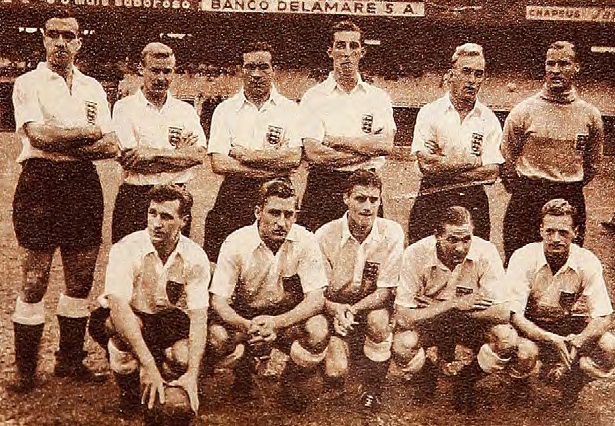
In the immediate postwar years England never tested themselves against the emerging powerhouses of central Europe, Hungary and Yugoslavia, or the top South American sides, so the statistics flattered them. More revealingly, they had lost 3-1 to Sweden in Stockholm and 2-0 at home to the Republic of Ireland in 1949. Nevertheless, their campaign started brightly enough with a 2-0 win against Chile in the Maracana, with goals from Mortensen and Middlesbrough’s Wilf Mannion.
But in the next match they lost 1-0 to the amateurs of the United States in Belo Horizonte, an early example of what English commentators like to call “second game syndrome” and outside observers will recognise as “choking”. Matthews was rested for the second game in a row, while Joe Gaetjens scored the winner with a header he knew little about, deflecting a speculative shot by Walter Bahr past Bert Williams. Some frantic, heroic defending by the Americans in the second half sealed England’s fate. England still had a chance to go through by beating Spain, but after a strong start in which Jackie Milburn had a headed goal wrongly ruled out for offside, their opponents grew into the match and scored the only goal, a header by Telmo Zarra, five minutes into the second half. Spain would go on to lose 6-1 to Brazil in the final group stage, so perhaps England’s departure was an act of mercy.
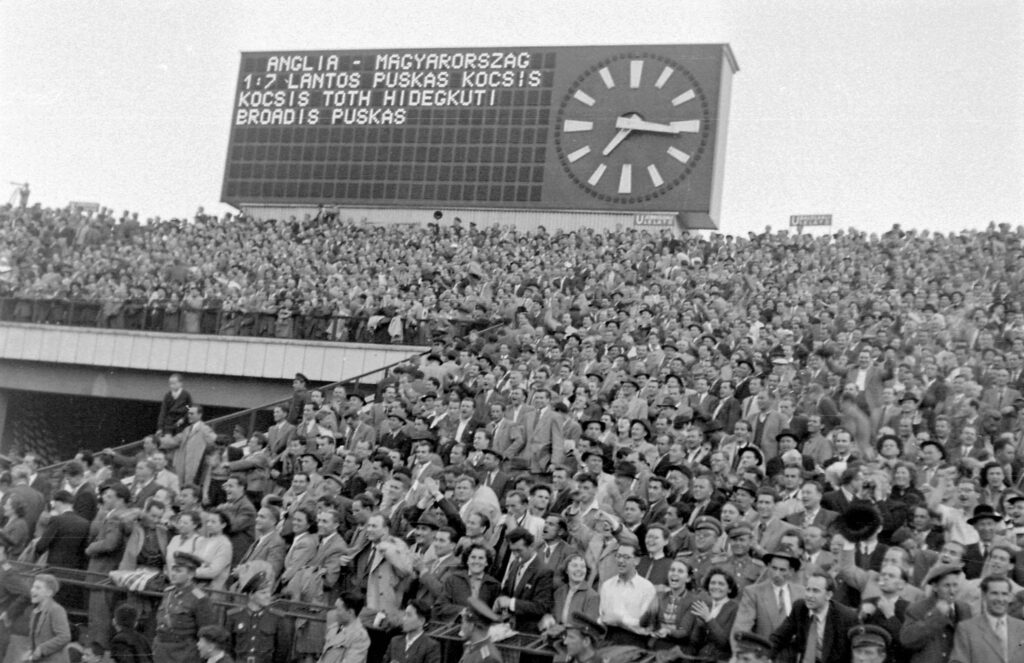
The 1954 World Cup in Switzerland is remembered for West Germany’s victory over Hungary in the final, but from an English perspective it was a debacle. They finally deigned to grace Hungary and Yugoslavia with their presence as part of their build-up and were sent packing: a 1-0 defeat in Belgrade was followed by a 7-1 dismantling by the Hungarians, who had famously won 6-3 at Wembley the year before. England’s manager, Walter Winterbottom, described the Hungarians as a “miraculous team”.
The historian Brian Glanville described the selection committee’s choices for Switzerland as “ridiculous”, with the uncapped Peter Harris of Portsmouth and Bedford Jezzard of Fulham, who had made his debut in the disaster of Budapest, leading the line. They opened with a chaotic 4-4 draw with Belgium that set another familiar pattern of throwing away promising early leads. It was the first World Cup match to be broadcast live on British television and probably sparked the first mass ejection of TV sets through living-room windows. England dominated the first hour and despite going a goal behind against the run of play, they were 3-1 up and strolling when their defence self-destructed and let the Belgians score twice in four minutes. Group matches in those days went to extra time, and England regained the advantage straight from the kick-off with Lofthouse’s second goal of the game, only for the hapless Jimmy Dickinson to head into his own net three minutes later. He remains the only England player to score an own goal in a World Cup finals match.

England recovered to beat the host nation, Switzerland, 2-0, and earn a quarter-final encounter with defending champions Uruguay. The Uruguayans had not started well, labouring to a 2-0 win over Czechoslovakia, but then thrashed Scotland 7-0 in their second match as the Scottish defenders, in the words of one English reporter, “stood around like Highland cattle”. England improved, with strong performances from the 39-year-old Matthews and Billy Wright, who had been moved to centre-half after the Belgium game to shore up the defence. But Uruguay, marshalled by Juan Alberto Schiaffino, were a class apart, while England goalkeeper Gil Merrick, the country’s most capped player at the time, let in two soft goals as the Uruguayans deservedly ran out 4-2 winners.
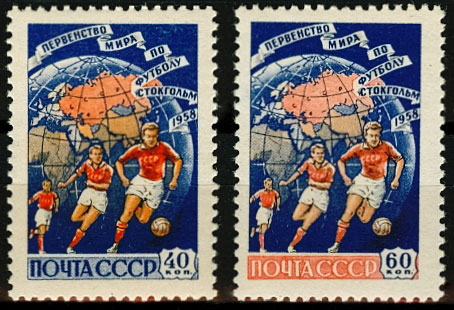
The 1958 squad was hit by the Munich air disaster, which claimed the lives of experienced Manchester United players such as Tommy Taylor as well as the promising Duncan Edwards. But it was far from the only setback. Neither Matthews, still in imposing form at the age of 43, nor Nat Lofthouse travelled to Sweden, and the 20-year-old Bobby Charlton, traumatised by the events in Munich, never got on the field. Once the football got under way they quickly ran into problems, going 2-0 behind to a Soviet Union side who had won the Olympic title two years earlier. England salvaged a draw with a debatable 85th-minute penalty and then drew 0-0 with Brazil, who were saving a 17-year-old prodigy named Pelé and the formidable winger Garrincha for their final game against the Soviets. England twice had to come from behind to draw their final match against Austria and earn a rematch against the Russians – in those days teams that were level on points had to play a decider if progress to the next round was at stake.
The teams were well matched for the first half and England had the ball in the net after the interval, but the referee spotted Peter Brabrook had handled before shooting. In the 69th minute England’s goalkeeper Colin McDonald sent a goal-kick straight into the path of Antatoli Ilyin, who drove forward, exchanged passes and finished with a low shot into the bottom left corner. The Soviets contained a late rally and England were out.
For the 1962 tournament in Chile, England drew Hungary, who had had to rebuild their team after the Russian invasion six years earlier. The legendary Ferenc Puskas and several of his team-mates at Honved, Budapest’s leading club, refused to return from a European Cup match against Athletic Bilbao and defected to the West. FIFA, helmed by the former Grimsby Town chairman Arthur Drewry, suspended the players for two years; Puskas had the last laugh by becoming a Spanish citizen and making the national squad for the 1962 tournament.
The new-look Hungary had beaten England 2-0 in Budapest two years earlier, both goals scored by their 18-year-old centre-forward Florian Albert. In their opening World Cup match in Rancagua, Hungary took the lead when England’s goalkeeper Ron Springett completely misjudged a shot by Lajos Tichy. England equalised from the penalty spot early in the second half, but Albert scored the winner two minutes later, beating Springett at his near post from a tight angle. In Glanville’s words: “England’s prosaic attack found Hungary’s packed defence an insoluble puzzle.” England recovered to beat Argentina 3-1 to notch up their first win in a World Cup finals match for eight years. But in their last game they could only manage a goalless draw against a Bulgaria team who had lost 6-1 to Hungary, and went through to the knockout stages on goal average at the expense of Argentina.
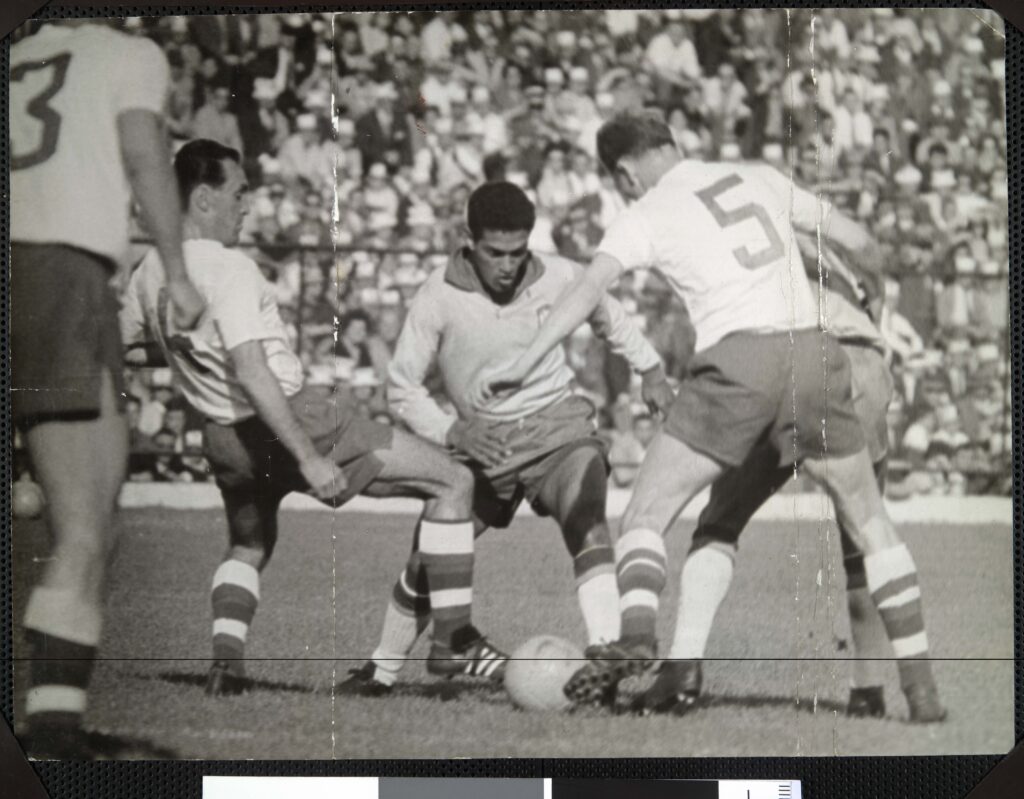
Their reward was a quarter-final against Brazil and the peerless artistry of Garrincha, the winger whom Pelé said he could never have won three World Cups without. Garrincha was simply unplayable: he danced and jinked, scattering England defenders in his wake like a lizard darting through a sandpit. The only creature that matched him for agility was a dog that ran on to the pitch early in the game and evaded the clutches of several players. England put two men on him, then three, but to no avail, and just when they thought they had the measure of him down the right-hand channel, the 5ft 7in Garrincha popped up on the other side to head in the opening goal from a corner. Brazil’s second goal was scored by Vava after a free-kick by Garrincha rebounded to him; Garrincha supplied the coup de grace just before the hour mark when he curled in a shot from outside the area that Springett barely saw. England had briefly given themselves hope when Gerry Hitchens equalised in the 38th minute, but Garrincha tore them apart. It was an individual performance to rank alongside Maradona’s wizardry against Belgium in 1986 and Zidane’s trouncing of Brazil in 2006.
England’s poor performances on the pitch might have been a factor in their decision to bid to host the 1966 tournament. Home advantage was a huge factor in the early World Cups: three of the first seven editions were won by the host nation and two others, Brazil and Sweden, reached the final. The main argument in their favour was sentimental: the FA celebrated its centenary in 1963 and one of the rival bidders, Spain, offered to withdaw “in a proof of homage and affection to the country which taught us how to practise football”. The remaining contender was West Germany, winners in 1954, so either way the tournament would be held in a country that had fought in the Second World War for the first time.
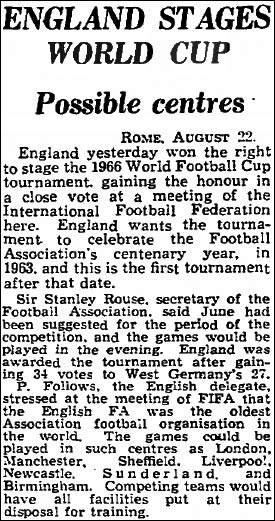
In August 1960 England got the nod at a FIFA conference in Rome, by 34 votes to 27. The respect and affection the rest of the world felt for English football was not mutual. The group stage match between two-time winners Uruguay and France, two countries that had done more than just about anybody to popularise the World Cup, had to be moved to the White City stadium because Wembley refused to reschedule its Friday night greyhound racing programme.
England’s team was a title contender at last and duly delivered the trophy, but normal service was soon resumed. They lost to Brazil again in 1970 and, after beating Romania and Czechoslovakia, threw away a two-goal lead in the quarter-final against the Germans, thanks in part to the antics of Peter Bonetti in goal. For the tournaments of 1974 and 1978 they didn’t even make it through the qualifying competition. When they lined up for their opening match against France at the 1982 World Cup in Spain, England had won a grand total of 10 World Cup finals matches, half of them at Wembley.
The sense of entitlement, however, the misplaced belief in the sanctity of the English game, persisted. The isolated triumph of 1966 fostered the sense that English football had nothing to learn from “the continentals”, despite results on the field pointing to the opposite conclusion. It took until the mid-1970s for English club teams to catch up with the tactical progress made in Europe and South America, at which point they started to sweep up European club trophies until the self-inflicted exile that followed the Heysel Stadium disaster.
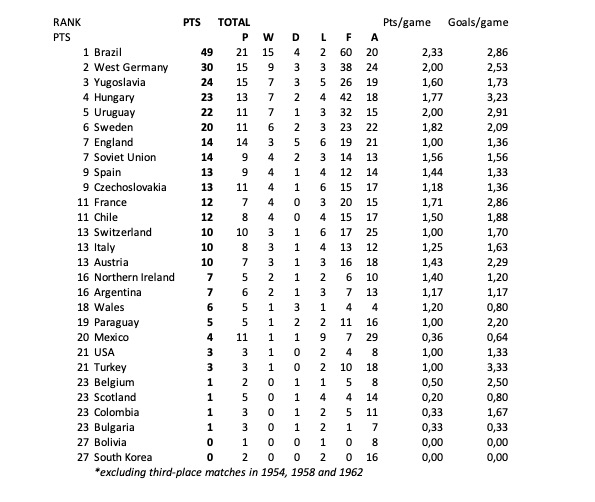
Mediocrity is a feature of England’s World Cup history, not a bug. Scottish fans who have had to endure jibes about their country’s dismal World Cup record can enjoy the fact that their first 14 matches yielded a comparable set of results to England‘s: played 14, won 3, drawn 4, lost 7. They might also have noticed how often goalkeeping blunders contributed to England’s early World Cup exits. England’s travails in the current World Cup would be familiar to the fans who endured their early World Cup exits: a lack of invention in midfield, a tendency to give away promising positions and an inability to win two games in a row. But their Achilles’ heel has always been the deluded belief, reaffirmed as recently as the half-time break against Ghana, that the opposition will eventually bow to their natural superiority. Until they shake off their complacency, England are destined to remain world football’s perennial underachievers.
Further reading: Brian Glanville, The Story of the World Cup
